

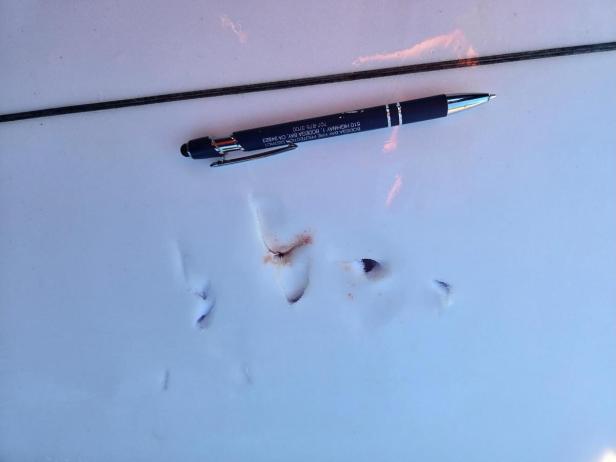
 photo credit: Sonoma County Sheriff's Office
Bite mark on a surfboard left from the non-fatal shark attack which injured the hand of a surfer at Salmon Creek beach in
Sonoma County on 12 December, 2025.
There's been a trio of shark incidents in the Bay Area's Red Triangle in December, including a fatal attack near Monterey.
The Red Triangle area of coastline stretches from Bodega Bay in the north, to Monterey in the south, and the Farallon islands west of San Francisco.
The area is known for its abundant population of sharks, and it's not out of the ordinary to see sharks in the ocean water of the North Bay, but two surfers got a closer run in with a one than they might've hoped in recent weeks.
On December 12th, a surfer was bitten on the hand at Salmon Creek State Beach, just north of Bodega Bay proper.
Ten days later, on December 22nd, another shark bumped a surfer off their board at Dillon Beach in Marin County, leaving a large gash in the fiberglass surfboard.
"This year has been very active relative to other years," said David McGuire. "There have been three [incidents] in December which is kind of unusual."
McGuire is a longtime shark researcher and advocate with Shark Stewards.
McGuire said the two North Bay incidents, and the fatal attack in Pacific Grove, have come late in the season - what's known to some as Shark-tober - when migrating great white sharks return to the California coast to feed on seals and sea lions.
"We see a peak in bumps and bites historically in the months of October and November," McGuire said. "September through November and tapering off."
Salmon Creek beach has gained a reputation as a shark hot spot, and McGuire speculates that some of the 10 recorded shark incidents at the beach could have been from salmon sharks drawn to what was once a site of salmon runs.
"But it's also fairly cloudy water when the creek is flowing and there's a colony of seals that haul out nearby," McGuire said.
Despite the attention that each shark incident garners, McGuire said it's important to note how few incidents have actually occurred on the Sonoma Coast since record keeping started in 1950.
"So 75 years of data," McGuire said. "We've had 16 encounters that have been confirmed with sharks."
McGuire has spent part of his career crafting policy to protect sharks, and he said that an important part of venturing into the ocean is understanding that sharks are a fixture of the environment.
"We're in a place that is still wild," McGuire said. "It's not a zoo. If people want to go somewhere that's perfectly safe, they should go to a swimming pool with a lifeguard."
McGuire said one common misconception about great white sharks: that they're more active at dawn and dusk. McGuire said Great White sharks are visual hunters, and that incidents are more likely to happen at midday, when the sun is brightest.

 NPR
NPR Spotify