

 photo credit: Shutterstock
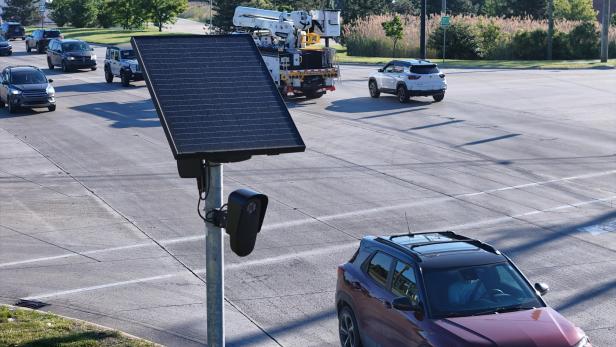
A solar‑powered license plate reader overlooks vehicles passing through an intersection.
Automated license‑plate readers have become one of the fastest‑growing surveillance tools in the country, and the private company behind many of them, Flock Safety, now has a growing network in the North Bay.
Cities say the cameras help solve crimes. Privacy advocates warn they create a vast network that can track people’s movements in ways most residents don’t see.
KRCB’s Shandra Back spoke with Press Democrat reporter Marisa Endicott about her reporting on license plate readers in the North Bay.
KRCB: After looking at how Flock — this private company and license plate reader system — is being used across the North Bay, what stood out to you the most about recent developments in your reporting?
ENDICOTT: I think what really stood out, and what privacy advocates have been sounding the alarm about, is just the vastness of this network. It’s used by so many agencies. And even though these aren’t cameras that are running all the time, they’re still picking up hundreds of thousands of data points that can essentially build what some people feel is like a GPS‑style tracking system. They’re just everywhere at this point.
KRCB: In your article, you referenced that San Jose’s cameras captured over half a million plates in just 30 days. And it makes me think: most of these plates aren’t connected to crimes. What happens with all of that information that’s constantly being collected?
ENDICOTT: Law enforcement agencies are very careful to point out that they’re not keeping all of this data indefinitely. Police departments have different retention periods. Up here, it’s 30 days for the most part. Rohnert Park had a longer one — about a year — but after a lot of public pushback, they recently shortened that to 30 days.
They say they’re only looking for specific hits and want to remind people they’re not constantly monitoring unless it’s for something specific. That’s at least how they frame it.
KRCB: In Rohnert Park, there was pushback. What was that pushback about, and what caused them to change that length of time?
ENDICOTT: Over time, this issue has been getting more attention from advocates and community members. License plate readers have been around for a long time, but now — especially with the current Trump administration and concerns around immigration enforcement and surveillance of protesters — those civil liberties concerns have really heightened.
In Rohnert Park, people were questioning what guardrails exist, what could be changed. Some were pressuring the city to get rid of the system altogether. The city didn’t want to do that, but they did talk about reducing the retention period.
KRCB: Flock is a private company, and it’s working with a lot of governmental entities. How does that relationship work, and what are some of the conversations around it?
ENDICOTT: It started primarily through homeowners associations, then expanded through community groups and businesses — that’s another big customer base for them. But more and more, cities and sheriff’s offices have become key partners.
I think they’re now in more than 5,000 law enforcement agencies. Law enforcement has become really dependent on the technology and has touted its benefits, especially rural departments with less staffing. They point to this as something they don’t want to move away from.
But the company says that when concerns are raised, the customer — the public agency — is in charge of the data. Researchers would dispute that and question who really owns the data.
KRCB: There have been a lot of ongoing conversations. In Rohnert Park, there was unrest that resulted in a policy change. What are the conversations like in Santa Rosa?
ENDICOTT: Santa Rosa has the biggest network. Some places like Petaluma, which have also drawn scrutiny, have four cameras. Santa Rosa has more than 120. SRPD has invested in technology for quite some time and really touts the benefits. There have been public hearings with a lot more community input.
The chief has said they’ve made some adjustments to guardrails and uses as they take in community feedback, and that he’s still open to it. But they seem very committed to this approach and to the benefits they say it brings to their crime‑fighting abilities.
KRCB: That’s a huge difference in numbers. Are there other counties or cities that have invested so heavily?
ENDICOTT: San Jose has hundreds as well. Oakland also has a considerable number. But when you think about the size of Santa Rosa compared to those cities, it’s definitely a lot — more than other North Bay cities.
And because these agencies all work together, when we talk about “the network,” it’s not that there’s literally a camera on every corner. It’s that agencies can access each other’s cameras. That’s what raises concerns about how much data is being pulled in.
KRCB: When we look at statewide concerns, what examples stand out to you?
ENDICOTT: There have been several instances where agencies were discovered to be looking up information for ICE cases. What stands out to me most is that departments will say they’re not using these for immigration enforcement — and many here, especially in the North Bay, say they haven’t found any issues.
But what’s important to keep in mind is that there’s a single point of failure. It can be hard to monitor. For example, if I share data, I might not share it with an out‑of‑state agency directly. But if another agency I do share with has an officer who runs a search on behalf of someone else, it’s very hard to close that loop.
Advocates say that’s where breaches happen — it’s hard to close all the loopholes.
KRCB: What were some of the surprising parts of your interviews with elected officials or people involved in these conversations?
ENDICOTT: What’s interesting is hearing people talk at these hearings about personal freedom versus public safety. There’s this fundamental question of which one you prioritize. They don’t have to be at odds, but there is tension.
As one advocate explained to me: What do you consider safety? Is it making sure a car thief is off the street? Or is it protecting your personal data? It comes down to what you consider public safety to be and what you’re willing to give up in one direction or the other.
KRCB: With ongoing coverage, what are you following? What do you expect to see in the future?
ENDICOTT: I’m watching to see what happens with the lawsuits that have been filed. There’s one police department that has been defiant of some state laws around data sharing — that case is moving forward and could have statewide implications. That’ll be interesting. And I’m watching how local communities decide whether they want to keep pushing back or not.

 NPR
NPR Spotify